
The difference between feature factory and outcome centric roadmaps
There are 4 things outcome-centric roadmaps have. That feature factory roadmaps don't.

Most product roadmaps are just a list of things to build.
Yours probably looks like this:
New dashboard
Payment integration
Mobile app improvements
Performance optimisation
That’s not a roadmap. That’s a feature backlog with dates.
And here’s the problem: You’re only building. You’re not learning.
I’ve worked with dozens of product teams over the past decade.
The ones that feel like feature factories have roadmaps that have one thing: solutions.
The ones that drive real impact have four types of work; and they’re all tied to strategic bets.
Here’s what outcome-centric roadmaps actually contain:
1. Opportunities
Address unmet customer needs. Improve customer outcomes.
Example: Improve expectation management in onboarding to boost customer satisfaction.
2. Initiatives
Build internal improvements that don’t directly touch customers but make the business run better.
Example: Improve CRM message flow so we can send more targeted messages at scale.
3. Discovery Initiatives
Talk to customers to understand their needs and problems better.
Example: Some customers don’t experience product value — dig into why through interviews.
4. Analysis Initiatives
Analyse data to understand patterns and behaviours better.
Example: Segment customers by whether they perform Action X — understand retention impact.
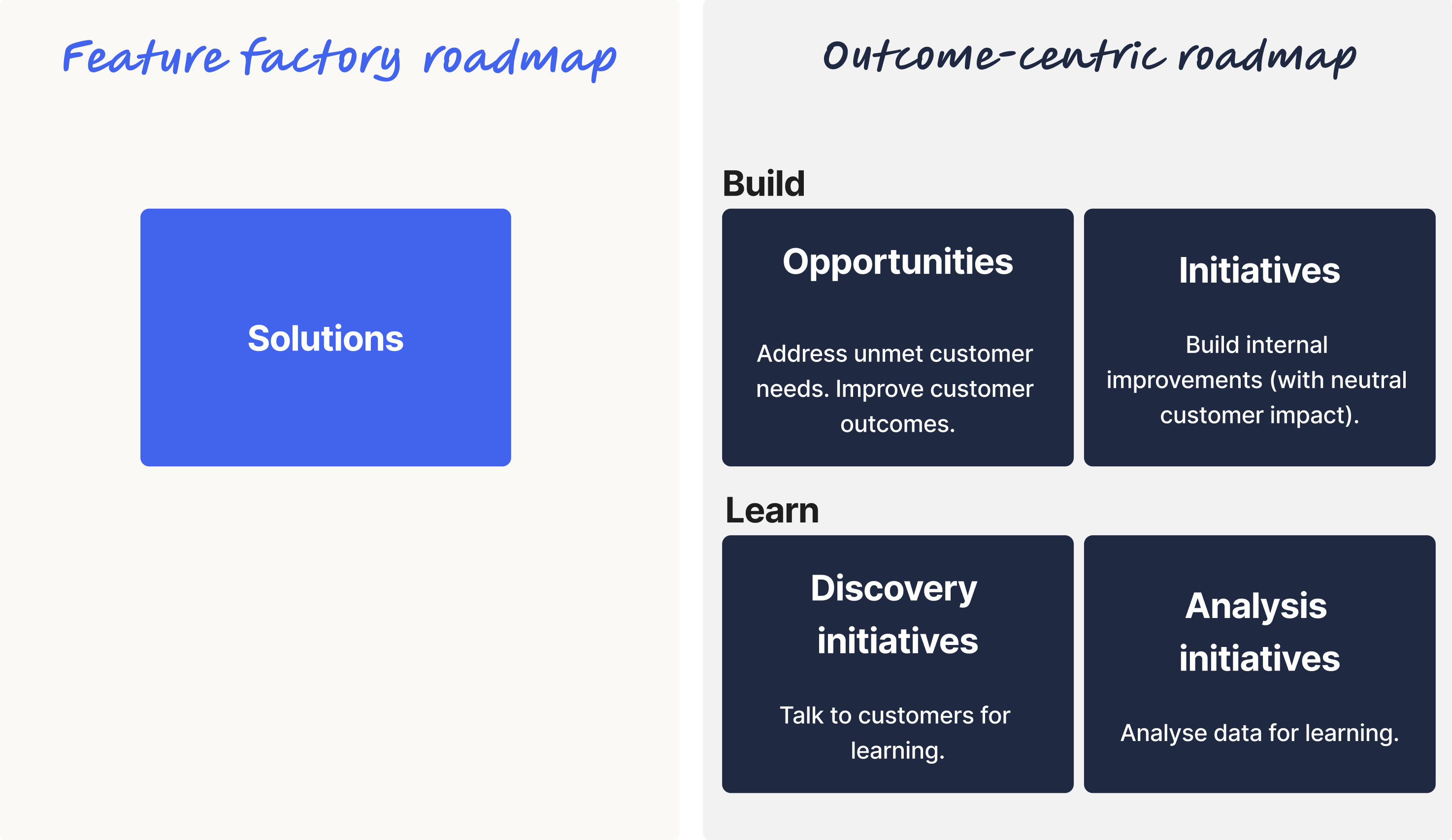
Notice something?
Only #1 and #2 are about building.
#3 and #4 are about learning.
And all four are tied to the same strategic bet: Improve 6-month retention by fixing Month 1 onboarding.
This is why outcome-centric roadmaps win:
They balance building with learning.
They don’t just ship features hoping something sticks.
They create a system where:
You build what matters (Opportunities)
You fix what’s broken internally (Initiatives)
You validate assumptions (Discovery)
You measure what works (Analysis)
All working together. All connected to business outcomes.
Here’s the shift:
Stop asking: “What should we build next?”
Start asking: “What do we need to learn to build the right thing?”
Your roadmap should answer both.
If your roadmap is just a list of features, you’re guessing.
If it has all four types of work, you’re strategic.
Want the full framework? I teach product teams how to build outcome-centric roadmaps that tie directly to business impact — no fluff, no theory, just the system I’ve used across three startups.
Cheers,
Igor